
The next time you face a slashed budget and reduced staff . . . the next time someone undermines your plans and you feel every ounce of positivity slip away, remember the name “Santiago Garcia.”
Got it? “Santiago Garcia.”
In the language of inspiration, it means “unstoppable.” In the vocabulary of vision it means “relentless pursuit.”
The name belongs to a self-taught artist who works quietly from his prison cell at Western Illinois Correctional Center.
A SKILL OF ANOTHER SORT
While Santiago’s skills with a paintbrush will never compare to the strokes of the great masters, he seems to have honed a skill of another sort: negotiating obstacles that threaten his progress, and—this is the “master-level” part—emerging from the struggle content.
Santiago enters the challenge with a grateful heart and exits with gratitude intact.
We don’t talk much about inner peace in the workplace. We are too preoccupied putting out fires and struggling to meet greater demands with fewer resources.
At the end of the day, however, many of us could use a master class with Santiago.

Santiago’s portrayal of his father, Miguel Garcia 
And his portrayal of his mother, Angelina Arriaya
MAKING UP FOR LOST TIME
Santiago came late to the table in developing his talent. He was confined to a maximum-security prison long before he picked up a paintbrush and long before he discovered the rules that govern his efforts—rules about the number and dimensions of allowed canvases, and ounces of allowed paint, and length of allowed brushes and wattage of allowed light bulbs and so on and so on.
Writing about “outsider art,” Bill Swislow pegs prison artists like Santiago as “textbook” outsiders.
- They engage in creativity apart from the art world.
- They have little or no training.
- They have little or no support.
- They work with limited physical resources and the “impoverished spiritual material” of their surroundings.
What Santiago lacks in resources, he makes up for in time. With a projected discharge date of March 23, 2035, he has time to figure out how to improve his skills within the framework of prison requirements. He has time to imagine and devise solutions that keep him moving forward.
Santiago “gets” what Jack London “got”—that life is not always a matter of holding good cards, but sometimes, just playing a poor hand well.
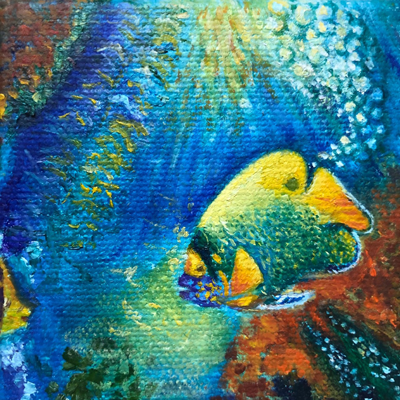
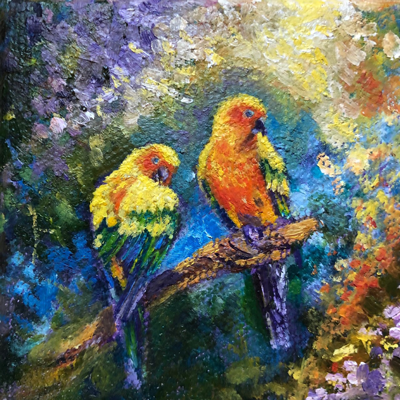
WHAT’S ALLOWED AND WHAT’S ON HAND
Santiago pursues beauty and grace in an institution defined mostly by shades of concrete. Men’s voices and the sounds of metal against metal echo at all hours. Still, he embraces every scrap of opportunity to learn about other artists, their tools and techniques, their colors and compositions.
Then, making do with what he can acquire and what’s allowed, he practices what he learns.

Santiago’s letters reveal a humble stream of gratitude, wonder and respect for his gift. At the same time, they reveal genuine appreciation for the obstacles that force him to grow in unexpected directions. Here’s a sampling:
Tender stewardship – “I’ve been incarcerated for over 18 years. While incarcerated, I received a gift for drawing and painting. I have developed this gift through studying art books and art magazines, and with a lot of work and practice.”
In good company – “Art materials are limited in the prison, and I must stick with what I am allowed to purchase . . . it was the same for many other artists. For example, Van Gogh struggled to obtain the materials to create his masterpieces. Old masters had to make their own pigments, brushes and supports. Some artists have a full time job just to acquire the tools they need to continue creating their art.”
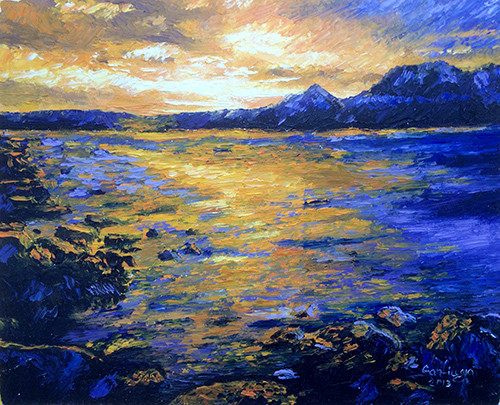
Joy in discovery – “I thought I’d never be able to paint. It wasn’t even possible for me to know where to start, but I liked to draw a lot even though I didn’t know anything about art. As you know, it wasn’t easy but I believe that if I had what I wanted from day one, I wouldn’t be doing the types of works and techniques I do now . . . we must improvise and adapt.”
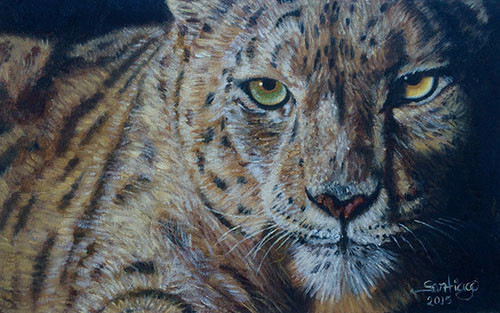
Grateful always – “I’m not complaining about not having the proper tools. To the contrary, it makes me appreciate them even more. It’s a struggle at first, but in the end, the outcome is worth the struggle.”
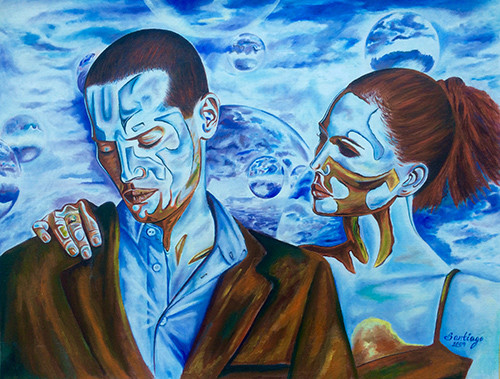
Contentment -“Through the years, art has become my peace, my freedom and my hope for the future. Art has become a part of me and defines the person I truly am. Art surrounds me. I dream and breathe it. It feeds me and even keeps me out of trouble. I understand that I won’t be a great artist like Monet or Rembrandt, but I know that I will always be an artist, and I thank God for this gift.”

Unstoppable – “It’s been a little cold outside, but my cell is warm . . . Even if it were cold, I don’t think it would be cold enough to stop me from doing some art.”
Worth sharing -“I want people to know that art is a powerful expression of life and rehabilitation for my soul. May God be with you all.”
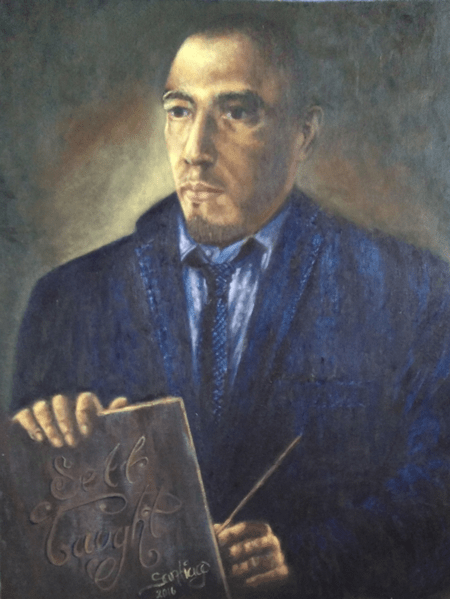
Top photo: Lion, oil on canvas, 12″x18″
All of the images on this page belong to Santiago Garcia and are used with his permission.
 Morris Sampler