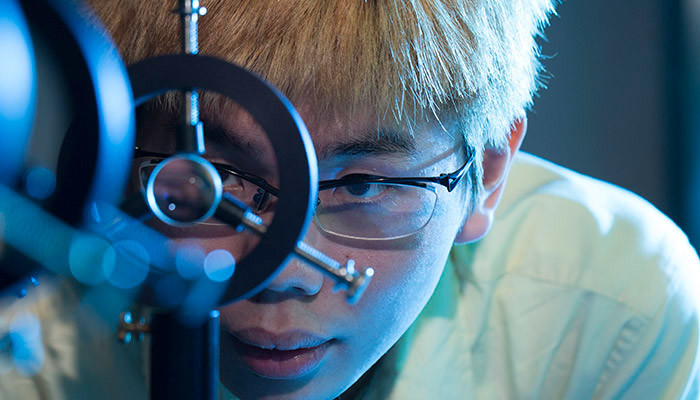
Entangled photons, cryptosystems, secure data transfer—the language of quantum information science fills the classroom as Shuto Osawa defends his undergraduate honors thesis.
Professors probe with questions; he responds with poise. They throw new ideas into the mix; he engages the concepts with confidence.
The give and take centers on the wonder of photons, tiny particles of light that hold the promise of faster and more secure communications.
But the exchange reveals other wonders too: the quantum leap in Shuto’s scholarship, the power of curiosity unleashed and the beauty of a budding passion for a discipline he knew nothing about just four years ago when he first set foot on Illinois soil.
6,000 Miles From Home
Then, 18 years old and nearly 6,000 miles from his home in northern Japan, Shuto struggled with the English language. His high school studies introduced him to reading and writing in English, but his arrival as a freshman at Greenville College in downstate Illinois revealed that university-level work demanded more.
Shuto faced the deficit head on, word by word by word. But even as he slogged his way through translations and dual meanings and exceptions in the English language, his curiosities in other areas soared. He yearned for a project that would engage his penchant for math and satisfy his desire to pursue something important.
Nothing materialized.
That was before Hyung Choi arrived at Greenville College to chair the physics department, before Choi ignited Shuto’s imagination with a course in quantum mechanics and before he asked Shuto and two other students to help build a quantum information lab in Snyder Hall.
It was before Shuto cemented friendships with his lab partners and grew fascinated with the development of true random numbers—a key concept to the security of computer systems and relevant to the study of photons.
“Quantum information science stole my heart,” he later confessed.
It was an understatement by any measure.
The Distant Dance
Instead of returning to Japan last summer, Shuto headed to Vienna, where he interned with Dr. Anton Zeilinger’s research group at the Institute for Quantum Optics and Quantum Information. Under the guidance of researchers, he worked at a table comprised of optical devices, lasers and crystals. He generated “entangled” photons—pairs of photons so inextricably linked that they interact with each other even when separated by great distances.
Researchers liken entangled photons to a pair of ice-dancers whirling away from each other, but with perfectly correlated directions of rotation. Even as partner #1 spins clockwise on an ice rink in Minneapolis, partner #2 exhibits the exact clockwise spin, on an ice rink in Paris.
Impossible, but no, wait . . .
Shuto explains his work with entangled photons in Vienna as a conundrum.
“In quantum mechanics, when we take measurements, the measuring corrupts the state of the photons, so they are not entangled anymore. But, if you don’t take the measurement, how can you tell they are entangled?”
Zeilinger’s researchers revealed several solutions to that puzzle. Buoyed by his breakthrough in understanding, Shuto moved ahead with his work in Vienna and then continued in the quantum science lab back in Greenville.
“Sometimes, I’d forget to eat,” he recalls of his time at the Institute. “There was no clock in the lab. If we work under the light, it can break the photon detectors, so we cannot really turn on the lights when we take the measurements. Basically, it is a dark room; the window is always blocked. Sometimes when I was done, it was 8 p.m. Sometimes I would work 12 hours a day.”
Beautiful Window Into the Unseen
If anyone appreciates the mystery of inspiration entwined with disciplined study, it is Hyung Choi. Inspired by light as a metaphor for God, Choi examined the nature of light in his doctoral research. He explains the quantum world as a strange and beautiful window into the unseen. Like Newton, Copernicus, Faraday and Eddington, Choi regards his study as part of a spiritual journey: “To me, knowing God and studying physics have never been two separate things.”
“He has good insight,” Shuto says of his mentor.
A Graceful Leap Beyond Expectations
The conversation lightens at the end of Shuto’s defense as he fields questions. Attendees learn that his academic work has garnered attention from several universities. He will begin PhD studies in electrical engineering this fall at Boston University with the University covering his full tuition and supplying a generous stipend.
His is not the last word, however. That goes to Choi, who reiterates to guests what most already know: “Shuto went well beyond the undergraduate level of research.”
The affirmation is a perfect send-off for the gifted scholar, who, after a pause for graduation, will continue pursuing the mysteries contained in tiny, entangled particles of light.
A version of this story originally appeared in the Summer 2016 issue of GC’s alumni magazine, The RECORD.
“I have no special talents. I am only passionately curious.” – Albert Einstein
 Morris Sampler