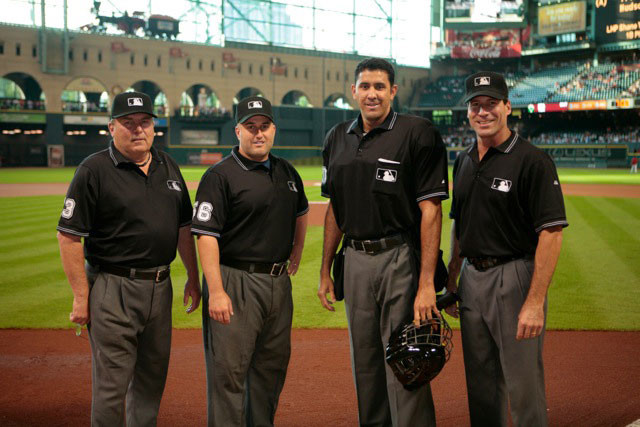
Delfin Colon will always remember July 28, 2008, as a night of nerves. That was the night 30 thousand stadium spectators, 18 television cameras, and countless home viewers watched his major league debut calling balls and strikes behind home plate in Houston’s Minute Maid Park.
It was a side of the plate few minor league umpires ever see—a side that promises more than the meager pay, budget hotels, tiresome travel and heckling that fill their days in the lower leagues. For Colon, it was a dream come true.
One Vacancy a Year
Only 68 slots comprised the roster of major league umpires. When Colon entered the system in 2000, and for the next 11 years, it averaged only one vacancy each year.
The minor league roster contained 225 slots—that meant 225 major-league hopefuls working grueling schedules; packing the miles on their own cars; taking hits regularly from wild pitches; enduring insults from spectators, players and managers; and missing their families. Their hope hung on the prospect of that rare call “up” to the majors.
Umpire schools add to the talent pool by graduating about 300 new candidates each year. Colon, a graduate of the Hunter Wendelstedt Umpire School in Florida, officiated nine minor league seasons before he was called up to the majors as a vacation fill-in.
“I was very lucky,” he says.
Wanted: Someone Who Can Protect the Integrity of the Game
Evaluators who recommend umpire candidates for positions look for qualities that protect the integrity of the game: good character, accurate judgment, a professional manner, confidence and a strong presence on the field.
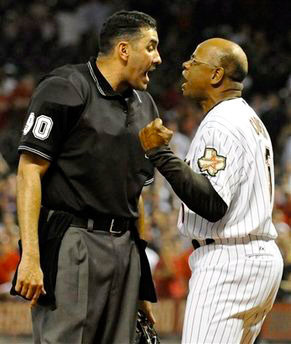
It’s a tall bill by any standard and a testament to an ump’s strengths. Colon’s natural curiosity about how people and things work helped him make the most of his experiences—a treasure in a field where experience is critical for advancement, but opportunities for experience are rare.
“You have to be able to learn on the job,” says Colon.
As a student at Greenville College (now Greenville University), Colon studied communication. It proved an asset in a profession where careless responses have dire consequences.
Hope Hangs on Leveling Up
Bulldog determination helped, too. When Colon entered the system, he promised himself that he would not quit. He discovered not giving up was easier said than done.
“I wanted to quit so many times, at least twice a season for whatever reason: I was homesick, I had a bad game, bad hotels, you name it. But, I knew all of that would improve at the next level. Every level I went up, it got a bit better and a bit closer to the big show. I was very lucky, and I have a great family that kept me going.”
Though Colon remained a Triple-A umpire, he called games for two seasons in the majors. The experience gave him instant credibility in professional circles, but true staying power eluded him.
He later moved on to umpire in his native Puerto Rico, a choice that allowed him to be closer to his family and help his mother since his father’s death. In retrospect, it was the right call.
Some summons, it turns out, eclipse even the majors.
__________
A version of this article originally appeared on greenville.edu; Photos courtesy Caleb Groom
 Morris Sampler