“Running solely on adrenalin” is how wood sculptor and exhibitor James Mellick described his experience last October at the end of ArtPrize 2016, a three-week international art competition in Grand Rapids, Michigan.
Four hundred thousand guests viewed exhibits in 182 venues as 1,400 artists competed for a half million dollars in prize money.
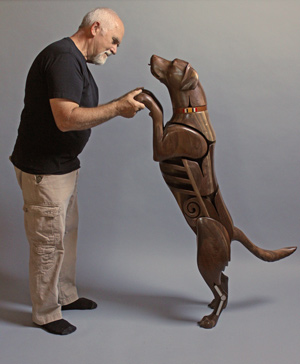
Visitors to Mellick’s exhibit, Wounded Warrior Dogs, outnumbered visitors to all other exhibits. Some waited in line up to 40 minutes to see the master craftsman’s work. Mellick conversed with visitors for 10-12 hours each day, often listening to personal accounts of battle wounds and canine heroes.
“It was intense,” he said.
Wounded Warrior Dogs placed first in the 3D category, earning Mellick a $12,500 award. In short order, however, he forfeited that prize to claim the grand prize, the $200,000 People’s Choice Award.
A Soldier’s Experience Told Through His Dog
By design, Wounded Warrior Dogs draws attention to issues that impact military veterans. It consists of seven service dogs—six encircling the flag-draped coffin of a seventh. Their arrangement replicates the solemn tribute paid to fallen leaders lying in state.
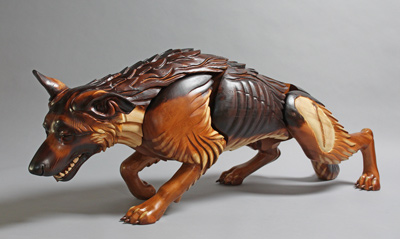
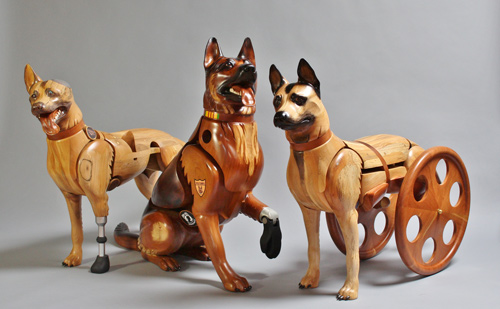
Carved from cherry, sycamore, walnut and cedar, the dogs bear wounds that their soldier-companions may have born—damaged eyes and ears, scars, signs of brain trauma and missing limbs. Some wear service medals that speak of deployments; some wear prostheses.
While Wounded Warrior Dogs appeals to dog-lovers and woodworkers, it’s the emotional response from military veterans and veteran dog-handlers that lends special validity to Mellick’s work. The display moves veterans to voice their experiences, often tearfully.
“I realized how their heartfelt responses transformed the Wounded Warrior Dogs project into much more than a mere installation,” he reflected.
The ArtPrize staff soon learned to keep Mellick’s space supplied with tissues.
More Than an Exhibit, a Catharsis
Though the artist has shown Wounded Warrior Dogs in other venues, ArtPrize 2016 marked Mellick’s first personal appearance with the display and his first experience of immediate public response. As the stories unfolded, each one seemed to add value to the project he began 20 months earlier.
Mellick takes 1-2 months to complete one dog, a process that allows time for him to meditate, listen and worship.
“The difference between the Christian and pagan artist is that our Truth lays beyond the self,” he observes. “Our truth seeking is beyond our own ability and is not self-centered.”
Wounded Warrior Dogs ultimately evolved into Mellick’s most purposeful and well-received art endeavor. Accepting the ArtPrize award, he called the project “God-driven.”
Gifted and Directed
Mellick understands his talent as God-given. He also understands that staying “tuned in” to God’s purpose opens doors to unexpected outcomes.
“When I try a new technique, [an] experiment or uncertain process, and it turns out better than expected, I’m always thinking thank you, Jesus. I’m aware all of the time that the sum is always turning out greater than the parts.”
Wounded Warrior Dogs resulted from an inspired revelation of sorts that began with the perceived need. Subsequent inspirations followed—“dog-by-dog”—about the elements and themes that defined each piece.
“There were so many doors opened and great timing and problems solved at the last minute,” Mellick recalls, “that I can only see it as Providential guidance.”
When art “goes right” for Mellick, it sets in motion a “wheel of meditation and praise.” He acknowledges being “in close communication with a Creator, who, I believe, really knows how to make things, having made the entire universe and everything in it.”
The Greenville College Connection

Professor Paul Wolber was among the guests to view Wounded Warrior Dogs in Grand Rapids. Wolber started the art major at GC when Mellick was a freshman. Mellick followed in Wolber’s footsteps by starting the art major at Houghton College, an early sojourn along the way in Mellick’s long career in art education.
Mellick’s wife of 47 years, Marcia (GC Class of ’71), also found a prominent place in the artist’s ArtPrize 2016 experience. He referenced Marcia in his acceptance speech as the “woman beneath his wings.” Her medical career provided financial stability when the artist was between teaching jobs and allowed him to produce art “even in a poor market.”
Wounded Warrior Dogs will be on display through March 26, 2017, at the Ohio Craft Museum.
 Morris Sampler