
The young family had moved to a town in a river valley that prevented clear TV reception without cable. Cable, it turned out, was pricey. To live within their modest means, they pulled the plug.
They kept the TV appliance for occasional use with a video player, but kissed network programming and 24/7 broadcasting good-bye. In the moment it took to yank a cord from a wall socket, they disconnected ftom:
- Laugh tracks and sitcoms,
- Monday Night Football,
- The Today and Tonight shows, and everything in between.
In the blink of a CBS eye they were a TV-less family.
Withdrawal
The abandoned device now sat like an afterthought on top of a bookcase in a guest room. Its sudden demotion had little impact on the three- and five-year-old, and none whatsoever on the baby. Mom and dad’s withdrawal brought the most discomfort. Was it their imaginations, or did other people talk inordinately about what they had seen on the screen the night before?
Months passed, and they survived surprisingly well. “What do you do?” others asked in disbelief.
Unplugged, the family simply found other stuff to do.
- They walked along the bluffs and ravines carved out by the Illinois River in centuries past.
- They discovered “elevated” sidewalks, and stairways that connected their upper town with the lower town.
- They found an old cemetery with limestone headstones, too worn for anyone to read, and little stone lambs curled up on the graves of infants. They wondered over the baby-deaths, and returned with crayons and paper to make rubbings of interesting designs and dates.
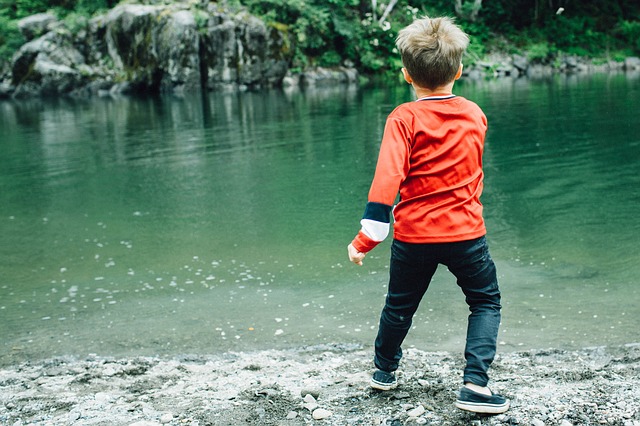
- They rode bikes along the old canal path that paralleled the river. Sometimes they’d dismount to skip stones and find nature treasures.
- They flew kites on a wide, open field north of town that someone told them was an Indian burial ground. The thought added mystery and wonder to each subsequent visit, like the one where they spread blankets on the mound and watched shooting stars.
Days filled with wonder
The family turned the concrete pond in their backyard into a gloriously huge sandbox where a gaggle of neighborhood kids dug canals, lined them with plastic grocery bags, and filled them with water from a garden hose.
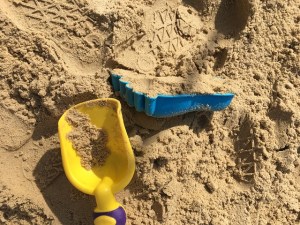
They built with wooden blocks and Legos and Construx on the front porch.
They built with giant waffle blocks, boxes and chair cushions. They made geodesic domes from toothpicks connected by marshmallows and delighted in their triangle-by-triangle growth.
They devised costumes, and pretended themselves to be royalty, pioneers, and musketeers, depending on the day, depending on the play.
They painted rocks, and discovered the pleasure of modeling warm homemade play dough.
They created elegant jewelry from treasures in mom’s button box and fashioned exotic tent dwellings with blankets, sheets, and colorful scarves.
They imagined themselves in worlds where daring, skill, and cleverness triumphed. They revisited those pretend places and added graphic details with each visit.
They read together.
The treasure trove at the foot of the hill
They checked books out from the little Carnegie library at the foot of the hill, a short walk from home.
- Mom read from the rocker on the front porch as the children played.
- She read from the couch in the living room, with a child snuggled close on each side.
- She read in the car as dad drove, on short trips, long trips, and everything in between.
- They read together in waiting rooms.
- They read at bedtime.
- They read on summer afternoons when the neighborhood play grew tiresome.
- They read on icy winter days when their snow-caked mittens and boots thawed out by the front door.
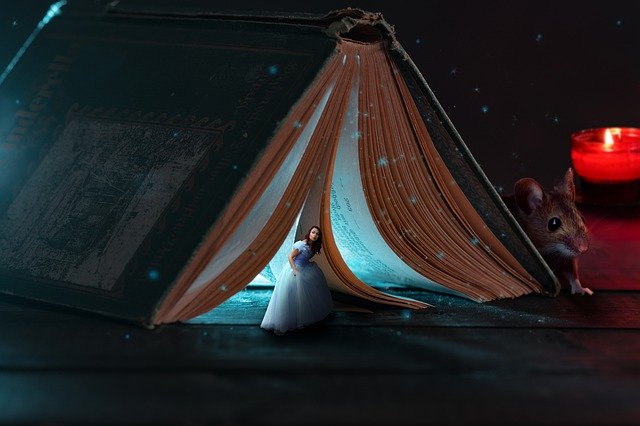
They alternated readers when one got tired, just to keep the story moving forward. When mom read the last words of Laura Ingalls Wilder’s The Long Winter, dad dashed out, book in hand, to trade it for its sequel before June, the librarian locked up for the night. The family discovered the joy of a consuming compelling stories together.
The joy of a shared journey
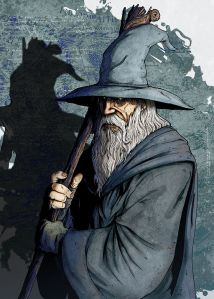
They read their way through tales that began with volume one and ended many volumes later: The Little House books, The Boxcar Children books, the We Were There books. They read their way through Narnia. They followed Meg through A Wrinkle in Time and beyond.
Tolkien’s Lord of the Rings made one child’s broken leg, traction, and weeks in a body cast somewhat tolerable.
They read tales of heartbreaking disaster:
- Shackleton’s Valiant Voyage
- The Raft
- The Disappearance of Flight 409
- The Devil’s Triangle
- The Chicago Fire
- Great Escapes
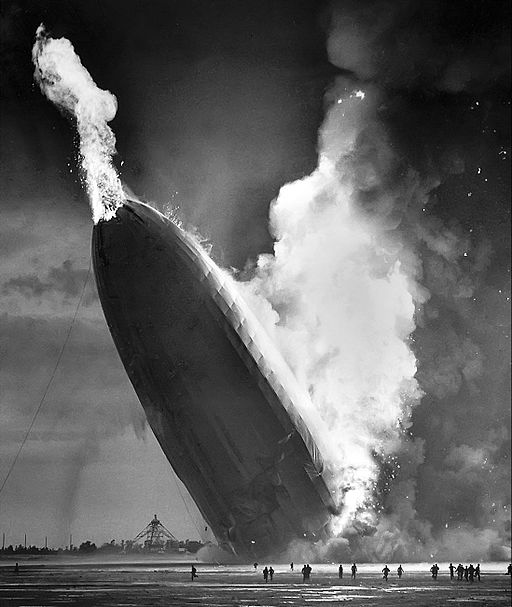
- They read about the Titanic, the Hindenburg, and Lusitania.
They read a biographic parade of generals and presidents and artists and inventors in no particular order. Norman Rockwell and Daniel Boone, Babe Ruth and Chief Pontiac, George Gershwin and Lewis and Clark; General George Patton, Amelia Earhart, Sacagawea, Helen of Troy, U.S. Grant, the Wright Brothers, Chief Black Hawk, and Julius Caesar.

The family’s reading list resembled a tossed salad of events, persons and dates.
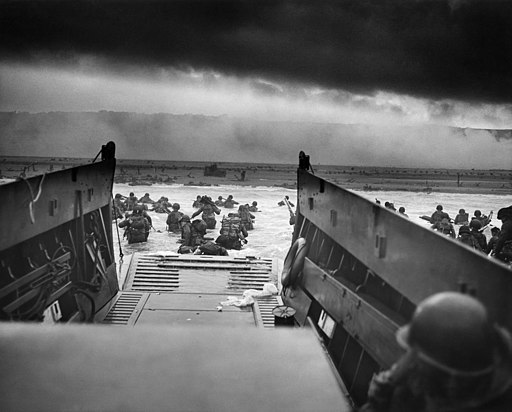
They read about great battles: Chancellorsville, the Bulge, Normandy, Gettysburg, Pearl Harbor, Lexington & Concorde, and Bataan. They went to sea on the Bonhomme Richard, under the North Pole on the Nautilus, and over the Atlantic on the Mayflower.
They developed an affection for rodents (Stuart Little, The Rats of Nimh), and rabbits (Watership Down); and compassion for travelers on hopeless journeys (The Trail of Tears, and I Am the Clay). They read of geniuses (The Chosen), myths (King Arthur), and living legends (Lawrence of Arabia).
Simply no room

“Unplugged” defined the family’s life, year after year, from one birthday to the next, season after season, graduation after graduation until the children left home to pursue their own, grown-up interests. Now that finances no longer dictate a TV-less lifestyle, the mom and dad continue in their unplugged state. Well-practiced and content living outside of the “box,” they simply have no room for it.
They, recent research tells us, are among the 1-2% of Americans who live an unplugged life.
Photos from top to bottom: (1) TV by Pexels from Pixabay ; (2) Skip stones by Jacob Johnson from Pixabay (3) princess story by Lisa Che from Pixabay (4) Gandalf: Nidoart, CC BY-SA 3.0 https://creativecommons.org/licenses/by-sa/3.0, via Wikimedia Commons (5) Hindenburg disaster Murray Becker/Associated Press, Public domain, via Wikimedia Commons, (6) Wright brothers: Unknown author, Public domain, via Wikimedia Commons (7) Normandy: National Archives and Records Administration, Public domain, via Wikimedia Commons (7) Plug: Image by Philip Pena from Pixabay
 Morris Sampler