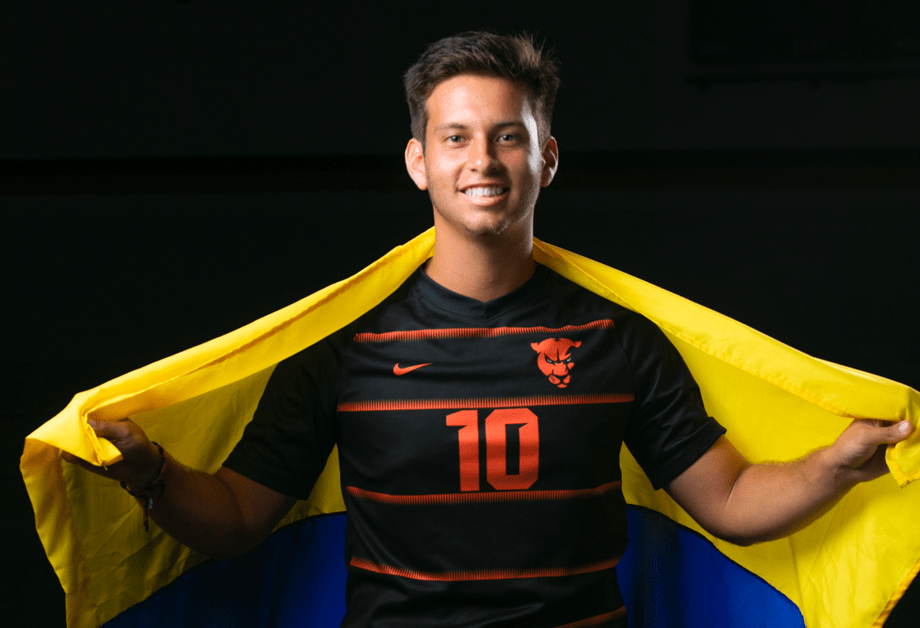
If there’s any truth to “use it or lose it,” then Spanish major Kyle Sunderland couldn’t have landed in a better place to improve his Spanish proficiency than on Greenville University’s soccer field.
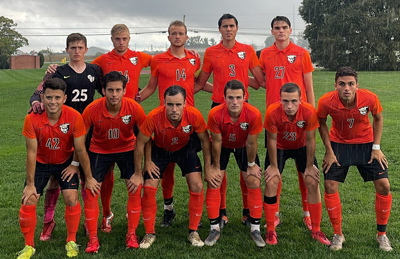
International players comprise about 78 percent of this year’s team. Kyle’s fellow midfielders hail from Spain, Mexico, Costa Rica, Colombia, and Ecuador.

“Anyone who has heard our team practice or play knows that mostly Spanish is spoken,” he says.
Engaging his Spanish on the field and off has improved more than Kyle’s fluency; it’s made him a more astute observer overall.
He’s seen that, just as his teammates from Spain speak a slightly different Spanish than those from Latin America, his teammates from Norway advance the ball differently than their South and Central American counterparts.

- Players from Brazil favor individual flair and creativity.
- Players from Costa Rica prefer short passes and lots of dribbling.
- Players from Scandinavia rely on tight formations with defined roles and little improvisation.
This year, players have also traveled from from Canada, Kenya, Brazil, Zimbabwe, Sweden, and Norway to play Panther soccer.
Kyle, a junior and longtime Greenville resident, says the diversity has “absolutely benefited me as a person and as a player.”
Growth, a two-way street
Kyle’s international teammates attest to growth as well.
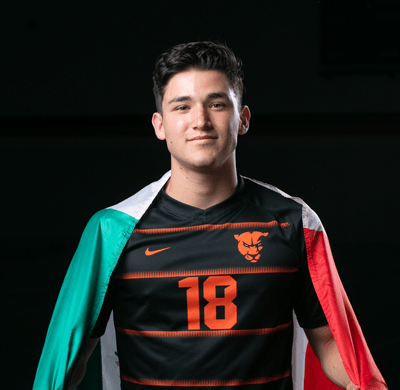
- Claudio Treviño says playing at GU has helped him “think faster with the ball [and] adapt to different formations and strategical positions on the field.”
- Ruben Martinez says it has helped him identify opportunities every day to learn something new that improves his performance “on and off the pitch . . . I have grown a lot.”
- Jose Soutullo Fernandez says the short collegiate season here in the States provides a “perfect scenario to build strong connections with teammates . . . one of the aspects that I love most.”
That these skilled athletes have traveled far to suit up as Panthers and play in Greenville amazes, blesses, and delights Kyle. But it doesn’t surprise him.
Christ-like character, putting others first
Kyle has played long enough as a Panther to know that, in addition to winning, his coaches value reaching out to others in Christ’s name, welcoming them, cultivating community, and advancing GU’s mission to empower students by developing strong character and hearts that put others first.
Panther soccer, it turns out, goes far beyond kicking a ball into a goal.
Inclusive by design
“Soccer at Greenville University is one way we are being faithful to our mission,” says Assistant Soccer Coach Ben Wayman, who also teaches theology in GU’s Bastian School of Theology, Philosophy, and Ministry.
He calls sport a great vehicle for friendship. To follow Jesus, he says, we need friends “because discipleship requires perspectives, support, and gift sets far beyond what any one of us can muster on our own.”
Wayman credits Head Coach Chris Swift for shaping a soccer culture at GU that extends the hand of friendship and fully embraces international players. A few examples:
- Music selections played on the field and during travel reflect different cultures.
- When a player’s national team wins a championship, he and his Panther teammates celebrate.
- English-speaking players are encouraged to learn and speak the languages of their teammates.
- Players pray in their native languages, reminding all of God’s diverse tapestry.
Coach Swift understands that culture permeates not just how his players approach soccer, but how they engage others, how they view the world, and how they connect spiritually. His appreciation for cultural diversity isn’t lost on his players.
“We all come from a different style of play and support the variety because we know it makes us better,” says Kyle.
Upping his game
“Competition is everything in sports,” says GU’s midfielder Benn Jane.
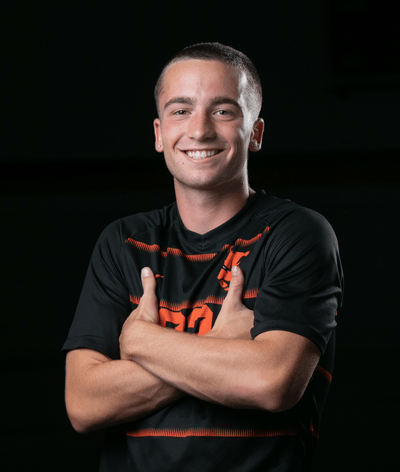
When Benn first arrived in Greenville to play Panther soccer, he faced a choice: (1) feel intimidated by the generous talent and skills international players brought to the field, or (2) find inspiration and motivation to improve his own game and prove his place on the team.
He chose the latter.
“We are not only learning about our fellow teammates, but we are competing with them to show them that we belong out there just as much as they do,” he says, “and it gives them incentive to work harder as well. I believe that playing with international players makes me a better athlete and a better person.”
That “better person” concept finds a place in Panther soccer by design. Wayman again credits Chris Swift for cultivating a culture that elevates “team” above self-interest. Wayman recalls the season that just concluded: “We regularly had players give up play time, privileges, free kicks, and even penalty kicks for the sake of their teammates.”
Beyond imagination

Research out of Duke University suggests that domestic students in the U.S., whose college experiences include high engagement with international students, benefit in surprising ways. They report significantly greater cognitive skill development than students with minimal exposure to international students—skills that include greater critical thinking and greater integration of ideas and information.
Wayman provides a case in point:
“In my Matthew, Mark, and Luke class, we had the privilege of hearing the gospel translated into Spanish and Portuguese by two of our men’s soccer players for their text analysis presentation. As a class, we considered together not only how different translations can give us a fuller picture of Jesus, but also how different experiences, cultures, and contexts can help us experience God in ways we could never have imagined.”
Athletes like Kyle, Claudio, Ruben, Benn, and Jose see diversity as an asset with great potential for making them better players. Then again, it may just make them better.
Top photo: Senior engineering major and midfielder Juan Garcia of Bucaramanga, Colombia.
A version of this story originally appeared on greenville.edu.
 Morris Sampler