
“Well officer, I was quietly minding my own business here in this church pew when the disruption happened.”
Really, there’s no better way to describe it . . .
A Sunday morning. From my place in a pew on the south side of the sanctuary, the image came to me all at once in my mind’s eye: a banner hanging on the front wall. I saw the whole thing in specifics–words, design, colors. I pulled out a pen and sketched it in the margins of my church bulletin. Its message? “I am the vine, you are the branches,” an image from John 15:1. Words filled the main panel. Grape vines ran the length of narrow side panels, six feet or more from top to bottom. That was just the start . . .
Then I envisioned a companion banner between the windows on the north wall. It said, “In Christ we live.” Another on the opposite wall said, “In Christ we love.” Banners flanking each of these mimicked the three-part design of the front banner. They each bore the image of an iris–a symbol for faith. One said, “Blessed Hope.” Another said, “Tender Mercy.” A third said “Indescribable Joy.” A fourth said, “Deep peace.”
Seven banners in all. Detailed. Complete. Unmistakable. Unasked for. What, I wondered, had just happened?
I didn’t have a name for it then, but I had experienced the Holy Spirit’s “nudge.” My pastor today calls it a “ping.” The Holy Spirit pings all of us, he says. Sometimes we ignore the pings. Sometimes we respond. I made the banners.




This happened in 2010.
Flash forward 15 years. Enter, the Holy Spirit, King of Ping.
Ping! Read the book of Revelation
“I’d rather not. It’s hard. It’s perplexing. I’m not up for apocalyptic mysteries in my devotional life. I prefer peace. Armageddon? No thanks. Maybe a Psalm?”
Then again, as part of my daily prayers I had prayed these words: “I receive now with humility the direction and provision of the Holy Spirit. Be praised, O Lord, and be pleased as You hear my prayers . . .”
Did I mean what I had prayed?
I will direct and provide. You receive.
“Revelation, huh?”
Revelation.
“It’s strange. It’s confusing. It’s violent.”
You can do this. Find a resource to help you get a lay of Revelation-land and make some sense of the confusion.
“Like Revelation For Dummies?”
That’s the idea. Then, pick a spot, any spot, and start sorting through the confusion. You can do this.
Hmmm. Sorting. I think immediately of Aurikatariina, “the Queen of Clean,” who vlogs about cleaning extreme messes in other people’s homes. She surveys the chaos, picks a starting point, and just digs in. Order comes. The surprising part? Joy comes. Taming the beast of disarray brings Aurikatariina great satisfaction. She can’t contain her joy. That’s the reason, I’m sure, for her many followers.

I can do this, I think.
Ping! Try the BibleProject.
Day one
BibleProject turns out short, animated videos to help people understand the Bible. Framed as stories, the videos are user-friendly, easy to consume, and simple–kind of like comics for adults.
I watch the Project’s two Revelation videos, about 20 minutes in total.
Day two
Ping! Watch them again.
I do.
Day three
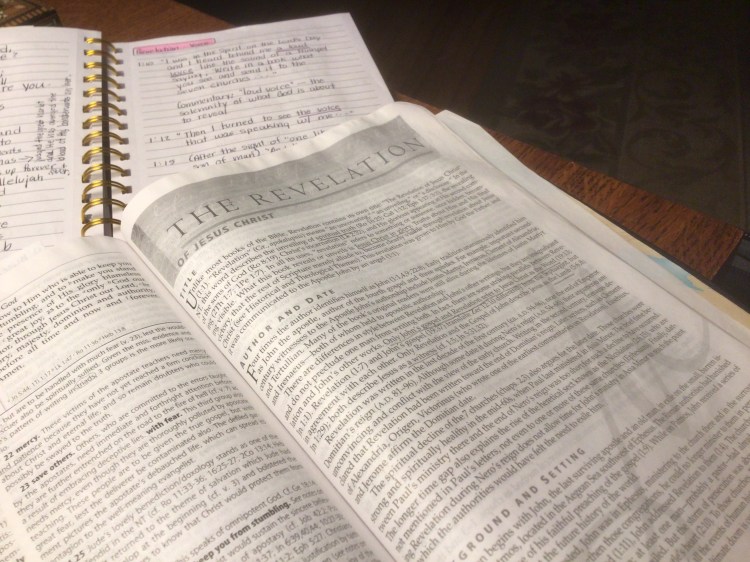
Ping! Read your study bible’s introduction to The Revelation of Jesus Christ.
I use the MacArthur Study Bible. I read its two-page introduction to Revelation.
Ping! Read it again.
Okay.
Day four
Ping! Read Revelation straight through, just to get a lay of the land.
I channel my inner Aurikatariina as she opens the door and steps into a new job. I survey the Revelation landscape. I don’t go deep. I just read through to see what each “room” (chapter) holds.
Word pictures abound–some strange, some familiar. I plow through the strangeness and find islands of relief in the familiar. Its author, John, uses images of his day to get his points across. I dust off my ages old cultural anthropology hat and put myself in his first-century shoes. I read about:
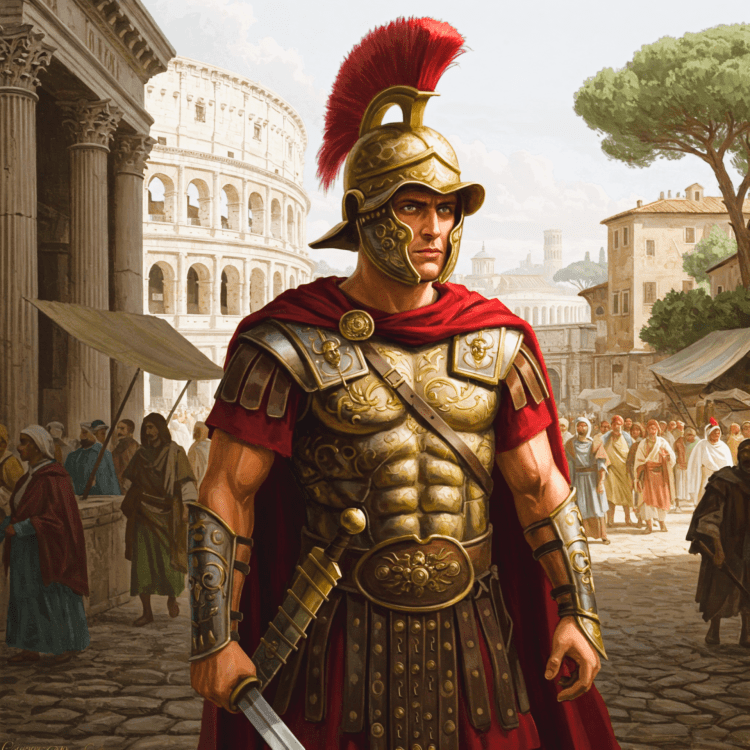
- Military conflict and the stuff of battle –swords, horsemen, army formations;
- Commerce and the stuff of Roman trade–gold, silver, spices, wine, and livestock;
- The value of money, the “denarius” for a day’s wage, and inflated prices during famine;
- Temple objects, lamp stands, scrolls, and incense;
- Farming tools–a sickle and winepress;
- Tools of justice, sealed documents, and rules, like the number of witnesses required for a legal proceeding.
- Symbolic currency, like the white stone ancient athletes received as their ticket to a winners’ banquet.
And then . . .
Ping! Start by sorting something that’s easy. Read Revelation again, but this time through the lens of persons. Just list the persons you encounter chapter by chapter from beginning to end. Don’t sweat the other stuff.
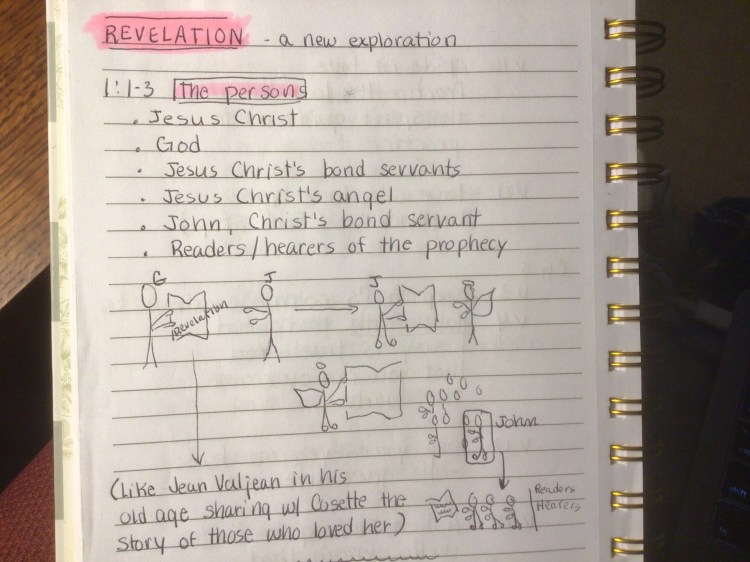
Sounds doable. I pull out my little spiral notebook and start a list: Jesus Christ, God, Jesus Christ’s angel, bond-servants to Jesus Christ, a named bond-servant (John, Revelation’s author), readers and hearers of the prophecy . . .
Whew! That was just the first three verses. But I need to back up again to see the relationships between these persons. Several attempts leave me confused.
Ping! Try drawing them.
I do.
My picture captures sequence:
- God gives the message called Revelation to Jesus Christ.
- Jesus Christ gives it to His angel.
- The angel gives it to John.
- John gives it to seven churches and to future generations, like me.
With a little help from a friend (a.k.a. the Holy Helper)
Ping! Think of Revelation like . . .
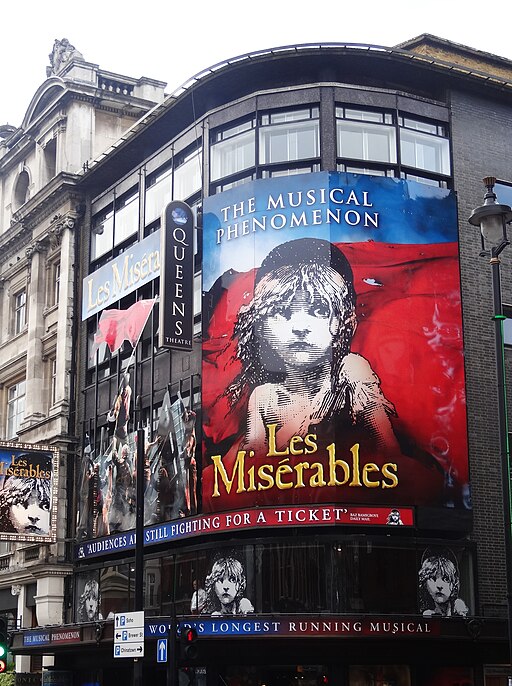
After I “sit” in these thoughts for a bit, a familiar image comes to me–the scene in Les Miserables where Jean Valjean, old and ready to die, pens his last confession. The audience eavesdrops as Valjean fills in blanks and creates a fuller picture for his adopted daughter Cosette: “It’s the story of those who always loved you. Your mother gave her life for you and gave you to my keeping.”
Revelation captures the story Father God gives to His son Jesus Christ. It tells of Christ’s first coming in humiliation and His next coming in exaltation. Readers like me “eavesdrop” on this gift that fills in blanks and tells the rest of a triumphant love story.
“Thank You, Holy Spirit, Holy Helper, for Your guidance. Thank You for answering my prayers.”
Ping! Before you leave, don’t you want to know what a bond-servant is?
I look it up. In Greek culture, bond-service meant involuntary permanent service. Think “slave.” But, in Hebrew culture, it meant the servant’s willing commitment to serve a loved and respected master. Revelation uses this elevated Hebrew meaning.
Ping! One last thing. Read verse three again and see that one detail . . .
Then I see it: “Blessed is he who reads and those who hear the words of the prophecy and heed the things which are written in it . . .” God wrote me into the story. I, a Revelation reader, will experience the goodness of God’s blessing. My knee-jerk dislike for the challenge of taking on Revelation softens.
Joy. Grace. Surprise. “Thank you, Lord.”
Beyond words

Chapter by chapter, persons parade before my eyes. Some resonate with me; others, not so much.
The letter writer, letter messengers, and letter recipients–I’ve been all three so they’re easy to understand. I “get” worshipers, witnesses to an event, victims of natural disaster, and a woman in labor. I understand merchants, musicians, a wedding party and guests–been there, done that. A rider on a white horse, a judge, warriors, and armies fill out my list of persons.
But I pause over tossing “angels” into the “person” bucket. And what about the lion, lamb, and eagle that John describes as worshipers surrounding the Lord’s throne? Then there’s a dragon and two beasts, one from the sea and one from the land. They speak with intent and seem to have “personality,” still . . . persons?
I scratch out the label on my persons bucket and make it “Beings.” The revision works.
Ping! Try a picture. Here, I’ll help . . .
Pictures help me grasp the abstract in a glance: The lightbulb in a cartoon character’s head shows “idea.” The white dove on a Christmas card says “peace.” The scales on an attorney’s business card speak “justice.”
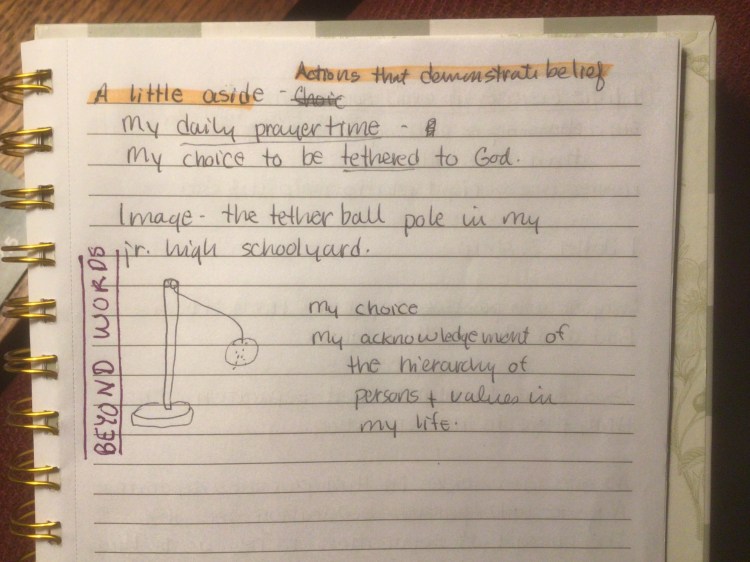
I’ve likened my daily prayer and bible reading to a picture in my memory, the tetherball pole in my schoolyard from long ago. These routines tether me to something bigger than myself. They right my perspective and align me with God’s perspective. Once I got that tetherball image “out” on paper, I better understood the idea behind it. The drawing clarified once messy thoughts and cleared the decks for “what’s next” in my thinking.
I discover that pictures–my own and others’–help me navigate Revelation.
Peter Jackson (yes, that Peter Jackson), my Holy Helper’s helper
I’m surprised how often images from Peter Jackson’s film trilogy The Lord of the Rings help me grasp big ideas in Revelation. Copyright protections prohibit me from sharing the movie images here, but icons from The Noun Project sort of work.

Past, present, future – Revelation captures what was, what is, and what is to come. That scope echoes the elf-queen Galadriel’s words in The Fellowship of the Ring when she invites Frodo to look in her magic mirror: “For it shows things that were, things that are, and some things that have not yet come to pass.” I hear Cate Blanchett’s voice even now in my mind.
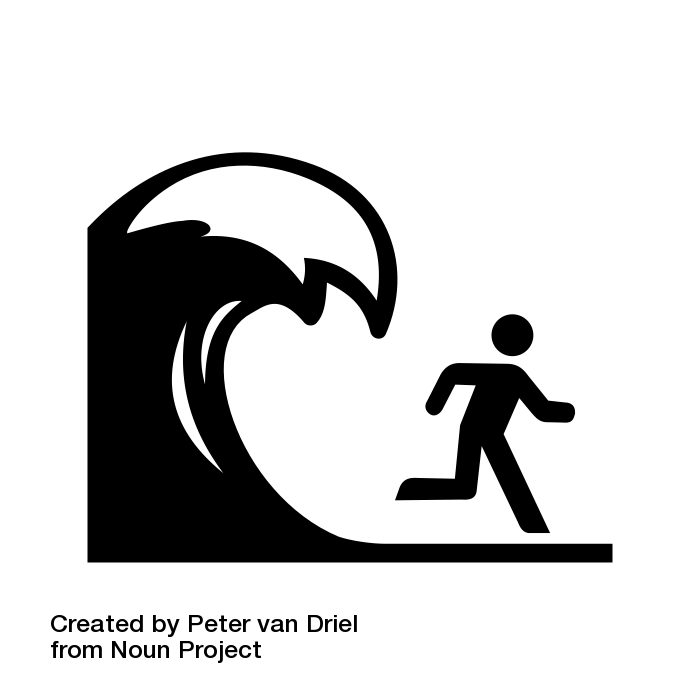
Swept away – “And the serpent poured water like a river out of his mouth after the woman so that he might cause her to be swept away with the flood . . .” (Revelation 12:15)
I imagine Liv Tyler as Arwen, chased on horseback by evil Black Riders. She crosses the River Bruinen and looks back to cast a spell on the water. The Riders attempt to cross, but the sudden deluge of rapids sweeps them away.

Birth of an evil being – “And the dragon stood on the sand of the seashore. Then I saw a beast coming up out of the sea, having ten horns and seven heads, and on his horns were ten diadems . . .” Revelation 13:1
I recall turncoat Saruman “manufacturing” warrior-orcs, a new breed of evil. They break out of their slimy birth sleeves and rise up, fully formed, bigger, stronger, and fiercer than any predecessor. Who could stop these conjured creations? Who could stop Satan’s conjured creature in Revelation?
Swift – “And the beast which I saw was like a leopard.” Revelation 13:2
My commentary tells me the leopard is a metaphor for ancient Greece with its swift and agile military moving forward in conquest. I think of light-footed Legolas, the archer-elf, who skims terrain that pulls his mortal and dwarf companions down. Unburdened like others, he even sleeps with his eyes open.

Resurrected in white – “And I saw heaven opened and behold a white horse, and He who sat on it is called Faithful and True, and in righteousness He judges and wages war . . .” Revelation 19:11
I picture Jackson’s portrayal of the good wizard Gandalf the Gray, once sucked down into a hellish fiery abyss, his grave. But, like Christ, he later appears, resurrected and “new.” Now, as Gandalf the White, he rides Shadowfax, “the lord of all horses,” also white. Throughout the land he is known as the White Rider.


Deceivers among us – Revelation calls out liars of all stripes–among them, those who make false claims about themselves, an influencer likened to Jezebel, and others who promote deception. It tells about Satan, the supreme liar and trickster, who “deceives the whole world.” It talks about his beast-agents whose lies appeal to the masses

I think how Jackson portrayed Wormtongue, the evil agent of Saruman. Posing as an insider in King Théoden’s court, Wormtongue whispers lies that pull the king under: “You are too old to rule.” “War is hopeless; resistance will only make things worse.” “Your allies are unreliable.” “I speak only for your good.” “Your story is over.” Fawning and smug, Wormtongue bows and bends and speaks in low, conniving tones. He insinuates and coils under a pretense of care, but he spews venom.
Overcomers – These imitators of Christ “eat of the tree of life,” receive “hidden manna,” and are not hurt “by the second death.” Jesus Christ includes them in future glory with Him.
I recall Jackson’s portrayal of Théoden, who appears at first like a living corpse whose relevance has faded with each submission to Wormtongue’s lies. We wonder, Can this once-great leader not even muster a scrap of will to resist this evil?
When Gandalf restores Théoden’s agency, color returns to the king’s face. His eyes clear. His voice strengthens. His stance straightens. He chooses to rise. He chooses to ride. He chooses to reign. My heart cheers.
Simmer, let it simmer, I say!

Ping! When a passage is hard, sit with it awhile. Let it simmer. Revisit it throughout the days when you’re on a walk or doing chores. Think about it when your hands are busy with something else. Give it time.

I do.
My imagining sometimes brings me back to my little notebook. Drawing stick-figure representations of Revelation’s message slows the deluge of confusion and helps me unravel mysteries, like the heavenly worship scene in Chapter Four.
I draw the images one at a time in the sequence John introduces them, starting with a throne.
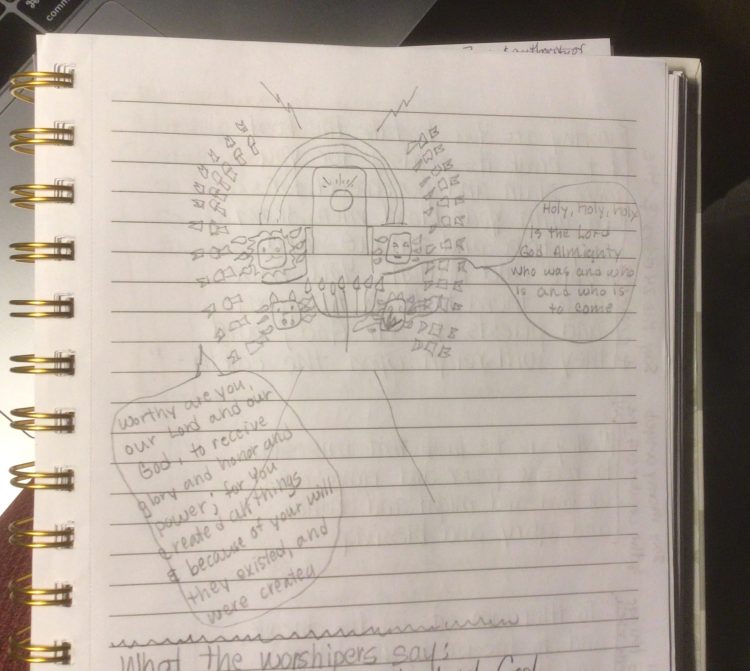
Praise swells from a few worshipers to many, then many more, and then an unfathomable many more.
- “Holy, holy, holy,” say the four living creatures.
- “Worthy are you, our Lord and God to receive glory and honor,” say a few more voices, 24 elders.
- Then the creatures and elders worship together–28 voices. They declare God’s saving grace extended to “every tribe and tongue and people and nation.”
- Then, “myriads of myriads, and thousands of thousands” of angels add their voices to the 28, roaring their declaration that Jesus Christ is “worthy to receive power and riches and wisdom and might and honor and glory and blessing.”
- Then all created beings in heaven and earth and “under the earth and on the sea, and all things in them” join the praise–a universe-wide unity of voice from town to town, sea to sea, earth to heaven, galaxy to galaxy.
While the unfolding image clarifies logistics, the process of drawing it has value that I can’t explain.
“Thank you, Holy Spirit-Helper.”
Instant Images
But not all relatable images require work and meditation. Some come immediately:
The “pit” – Revelation 9 tells of a fallen angel, likely Satan himself, who holds the key to a bottomless pit where smoke rises up “like the smoke of a great furnace that darkens the sun and the air.”
I think of my visits to Menard Correctional Center, Illinois’ largest maximum-security facility. Inmates, staff, and even visitors call it “The Pit.” A sense of hopelessness pervades this notoriously dark and dangerous place. Journalists tell about violent inmates cramped together3 in sweltering quarters and cells the size of a parking space. Inmates tell abut being thrown in “the hole” for solitary confinement. Class action lawsuits tell about their physical abuse, sexual humiliation, and property destruction at the hands of tactical guard units4 in search of contraband. Prisoners call these orange-clad havoc-wreakers “Orange Crush.” The bottom line? A life-sentence in Menard means day after day of never-ending darkness, a “bottomless pit” like the one in Revelation 9.

“I just want to die” – Revelation 9:6: “And in those days, men will seek death and will not find it. They will long to die, and death flees from them.” I think of Staff Sergeant Joe Toye in Stephen Ambrose’s Band of Brothers. Who could forget the image from the acclaimed mini-series of a grenade detonating between Toye’s legs? He received wounds from artillery fire and wounds from shrapnel, enough to earn four purple hearts. After one hospital stay, Toye rejoined his company at Bastogne, only to lose a leg in an explosion. “Jesus Christ, what does a guy have to do to get killed around here?” he asks.
Unstoppable – Revelation 13:4: “. . . they worshipped the beast, saying, “Who is like the beast and who is able to wage war with him?” The cult of personality and influence known as “Hitler Myth” immediately came to mind. World War I had left the German people humiliated and in chaos. One Berlin laborer said, “After all these sad events, was there any wonder that the whole of Germany yearned for a man who would sweep out the Augean stable with an iron broom?”5 Enter, Hitler, with supreme oratory skills, charisma, and appeal. In Revelation, enter the beast.
Fake vs. Truth – Revelation 13:15. Time for a clarifying picture . . .
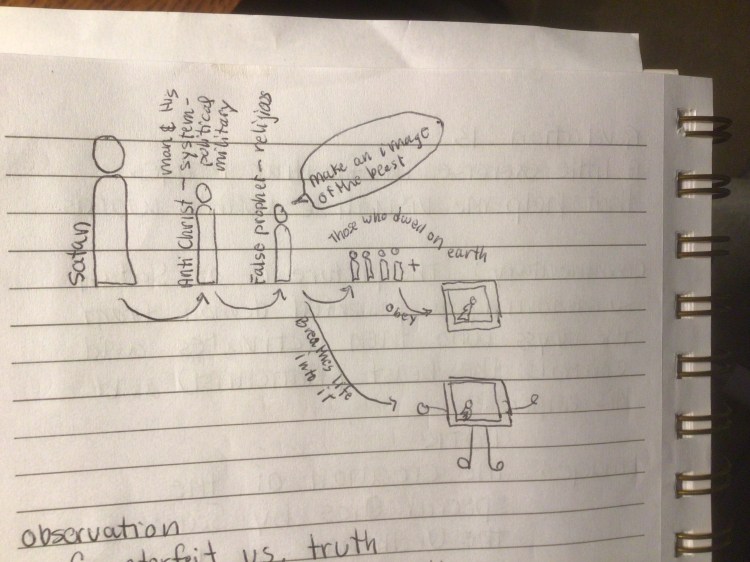
. . . and the strange story it captures. This supreme evil being gives agency to another being, who influences social, political, and military systems. This “agent” endorses a spokesperson-press agent, who calls for images of the influencer to be made and distributed. Persons throughout the world see the images and obey them and treat them as authentic.
Crazy? Not so much when I think of news clips that come to me through my computer screen. Easily edited and manipulated, these recordings of living images (not the real thing) stir deep emotions with spin that wins others over.
Bad dogs – Revelation 22:15 contrasts Christ followers with agents of brewing evil who remain outside city walls: “ . . . the dogs and the sorcerers and the immoral persons and the murderers and the idolaters, and everyone who loves and practices lying.”

I “hear” Elton John singing, “So good-bye yellow brick road, where the dogs of society hound . . .” The opening scene in Wuthering Heights fills my mind’s eye–a front room occupied by snarling, attacking, affection-less dogs. A first-time visitor to the dark and trouble-filled house said, “A brace of them sprang from the kennel, and fell upon me, gnawing and worrying my coat-tails.” These remembrances help me see the insidious evil embodied in the familiar–man’s best friend.
Try a different lens

Ping! Sort through Revelation a different way. Blessings await . . .
During my “round one” sort of persons/beings, I make a margin note to go through all 22 chapters again, but this time looking through the lens of “voice.” I had seen the word enough to know that I might profit from a “round two” journey in that direction.
Then, a pattern emerges: When I read Revelation through one lens, the prospect of another lens comes to me. I list the lenses in margin notes and cross them off when I complete each round.
People
Colors
Declarations that words are true
Voices
Worship words/prayers
Light/lightening/thunder
Overcomers
Names for Christ
“About-face” transformation
I lose count of the number of times I read through Revelation. Each read-through enriches me in some new way. Days reading Revelation pass. Weeks, and then months. I emerge from the process knowing:
- Creating order out of chaos gives me a measure of satisfaction–enough satisfaction to want to sort more.
- Prayer is a two-way street. The Holy Spirit/Helper sometimes initiates conversation that takes me to places where I would not go on my own.
- What I learn gives new meaning to the prayer I say daily:
“I rise from the rest you have given me, O God, grateful for all you provide.”
“I remember with joy the favor you have lavished on me in Jesus Christ.“
“I receive now with humility, the direction and provision of the Holy Spirit.”
Each read-through of Revelation reveals new reasons for gratitude.
Each pass through amplifies hope and joy.
My experience bears out the words of Jesus in John’s Gospel: “But the Helper, the Holy Spirit, whom the Father will send in my name, He will teach you all things, and bring to your remembrance all that I said to you.” (John 14:26)
“Be praised, O Lord, and be pleased to hear my prayers.”
Just a scrap

Sometimes I need to remind myself that pleasing the Lord is doable–that we, in our woefully sinful condition, can please Him. The Psalmist said the Lord “delights in those who fear him, who put their hope in his unfailing love.”
I treasure the words of Bishop Robert Barron, who tells me that all God needs to begin a work in me is the smallest scrap of repentance that I can muster.6 I believe–indeed, I have seen–that if I give God even a scrap of my attention and will, He works with it and grows it and blesses it in ways I can’t imagine. Is that not a love story worth celebrating?
The icing on the cake: My heart sings
There’s no getting around it: I’m a sucker for compelling word pictures. Writers and speakers who use them pull me in. Hockey games stir passions in some people. Strong messaging does it for me.
I’ve been listening to Bob Dylan a lot lately as I putz at projects around the house. Christopher Ricks, editor of The Oxford English Book of Verse, called Dylan “the greatest living user of the English language.”7 Then again, Kurt Vonnegut called Dylan the worst poet alive.8 Whatever . . . I do know this: Good or bad, Dylan paints vivid word pictures:
- “Two riders were approaching, the wind began to howl . . .”
- “Take me on a trip upon your magic swirlin’ ship . . .”
- “The dirt of gossip blows into my face, and the dust of rumors covers me . . .”
- “I saw ten thousand talkers whose tongues were all broken . . .”
- “That long black cloud is comin down . . . I feel I’m knockin’ on heaven’s door.”
And what about John, the fisherman-turned disciple-turned apostle-turned messenger of divine revelation? His vivid imagery cuts to the chase with urgency. It’s the icing on the cake for me–one compelling word picture after another:
- “I fell at his feet like a dead man”
- “A great multitude, which no one could count, from every nation and tribe and peoples and tongues . . .”
- “I stand at the door and knock; if anyone hears my voice and opens the door, I will come into him . . .”
- “He . . . showed me the holy city, Jerusalem, coming down out of heaven from God, having the glory of God. Her brilliance was like a costly stone, as a stone of crystal-clear jasper . . .”
Ping! List the word pictures that make your heart sing.
I do. The length of the list surprises me. Gratitude deepens.
And the cherry on top — “Come away with me.”
Some years ago, I’d stir from a good night’s sleep into the land of wakefulness and hear Norah Jones’s voice in my mind’s “ear” singing, “Come away with me . . .” Morning after morning, remembrance of that soft invitation ushered me into wakefulness until I realized this wasn’t just my remembrance of a radio tune. This was a nudge, a “ping” to rise out of my bed in the fresh early morning hour of a new day, to pray and read scripture. It was the Holy Spirit nudging me to yield to something bigger than me.
Ping! Come away with me . . .
I’m so glad I did, but oh that I would get better it.
- From Revelation 1-11 by BibleProject ↩︎
- BroadwaySpain, CC BY-SA 4.0 <https://creativecommons.org/licenses/by-sa/4.0>, via Wikimedia Commons ↩︎
- Martindale, Dayton. “New Lawsuit Alleges Systemic Abuse of Solitary Confinement in Illinois.” In These Times, June 25, 2015. Accessed February 27, 2026. https://inthesetimes.com/article/new-lawsuit-alleges-systemic-abuse-of-solitary-confinement-in-illinois. ↩︎
- Brian Dolinar, “Orange Crush: The Rise of Tactical Teams in Prison,” Public i Contact, February 23, 2017, accessed February 27, 2026, https://publici.ucimc.org/2017/02/orange-crush-the-rise-of-tactical-teams-in-prison/. ↩︎
- William L. Shirer, The Rise and Fall of the Third Reich: A History of Nazi Germany (New York: Simon & Schuster, 1960), 143. ↩︎
- Robert Barron, “The Conversion of Saint Paul,” YouTube video, 11:20, posted by Word on Fire Catholic Ministries, January 25, 2015, https://www.youtube.com/watch?v=Hk0Zk4oGQkY, accessed February 27, 2026. ↩︎
- Christopher Lydon, “America’s Greatest Living Writer?” Radio Open Source (blog), Medium, accessed January 28, 2026, https://radioopensource.medium.com/americas-greatest-living-writer-f8b90437a6ae. ↩︎
- Matthew Strauss, “Kurt Vonnegut in 1991: ‘Bob Dylan Is the Worst Poet Alive,’” Pitchfork, October 20, 2016, https://pitchfork.com/news/69151-kurt-vonnegut-in-1991-bob-dylan-is-the-worst-poet-alive/ ↩︎
 Morris Sampler