“Know first who you are; and then adorn yourself accordingly.” — Euripides
Daring, noble, smart, and shrewd, d’Artagnan wore his confidence like the deep scarlet muskateer cape that draped his shoulders and the plumed hat that graced his head. Brave and ambitious, he commanded respect from his fellow musketeers with each gallant stride.
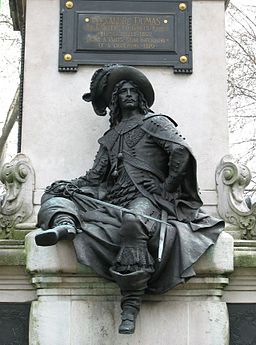
The kindergartener chose his clothes that morning with care. He drew a generous bath towel about his shoulders and secured it with a large safety pin. A curtain rod tucked into his Batman belt served both as a sheath and sword. He pinned a flowing, feather-light, plastic grocery bag to the band of a straw hat that he got on a trip to Amish country. He tugged on his big sister’s tall winter boots, and tucked his pant legs into them.
Transformed, he greeted the new day as d’Artagnan.
Even at age five, he appreciated well-appointed details. A shortage of fashion funds rarely put a damper on his dressing for success. The special gift he possessed, to see what he wanted to see when he looked in the mirror, covered a multitude of costuming flaws.
Preparing for play, he caught a clear vision of his character, his mission, and the challenges that awaited him in the backyard or alley behind the house. The details emerged as he set out his gear. He envisioned the victorious outcome and the struggles he’d have to endure to get there.
Characters from stories drove his fashion sense. The process often began with a hat.
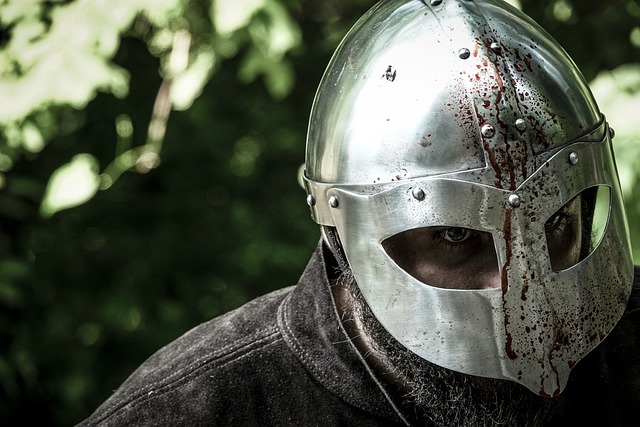
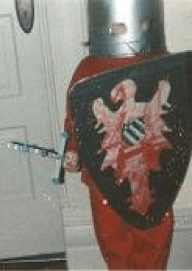
As a knight of the round table, he labored over the details of his armored headgear (an inverted plastic gallon ice-cream bucket with cut outs around the eyes to resemble a helmet like the one he spotted in a library book). He was particularly pleased with the part that extended down over his nose – a critical, protective detail. Once he covered the whole thing with layers of duct tape, it mirrored the one he saw in the book.
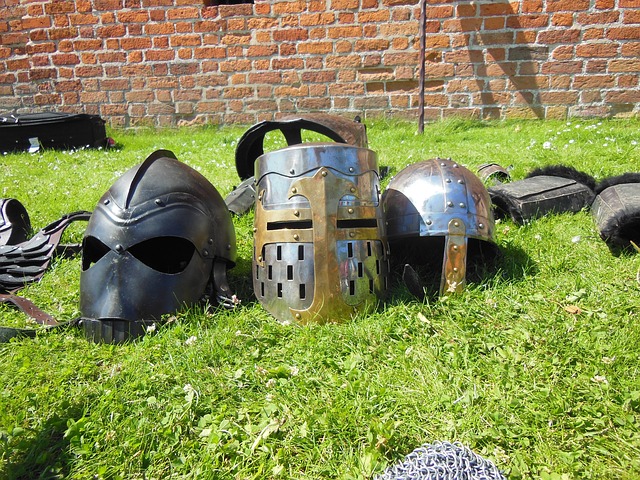
As Audie Murphy, he fashioned a scrap of fishing net into a cover for his plastic army helmet. Now, he could stick leaves in the netting for camouflage, transforming the helmet from a plaything to real.
Inspired by this beginning, he donned olive drab cargo pants with lots of flapped pockets, and a green duck photographer’s vest that someone gave him, with even more pockets. He stashed all those pockets with grenades, ammo, and handguns built out of plastic Construx. The hours it took to create this authentic “look” gave him great satisfaction.
Authentic
Somewhere between the ages of five and seven though, his standards for “authentic” changed. A steady stream of non-fiction, chapter books fed his growing passion for World War II. He pored over pictures of tanks, artillery and side arms. He asked endless questions about all things military: weapons, armor, vehicles, tactics, campaigns, and personnel.
He had an uncanny knack for recalling military and historical facts, but couldn’t seem to manage common directions like, “Wash your hands and come to the table.”
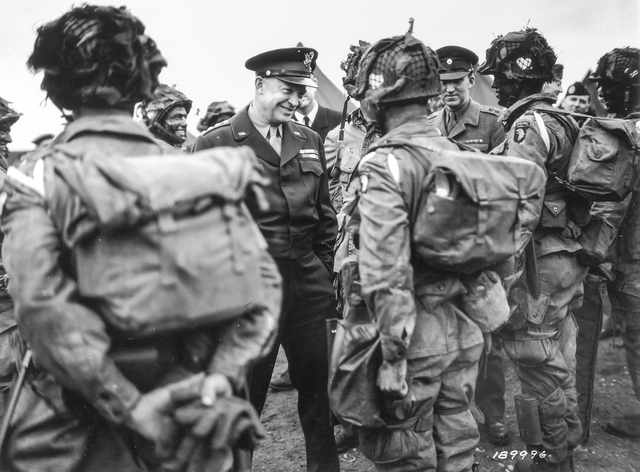
He used his Christmas money to purchase a six-part video series on Eisenhower’s campaign in Europe. He knew generals’ names and the paths their men forged.
He knew all about German U-boats, the Japanese Zero, the Brits’ Supermarine Spitfire, and the amazing Corsair fighter-bomber. He cheered the arrival of the B-17 Flying Fortress and the B-24 Liberator bomber.
He advocated for a family vacation to Iwo Jima and Pearl Harbor. He listened raptly to stories of war heroes: Butch O’Hare, Dick Bong, and Murphy.
Ultimately, his more sophisticated understanding of soldiery brought with it a desire for “real” gear. Above all else, he longed for an authentic WWII helmet.
The Vision
He had already replaced the batman belt with a vintage WWII web belt that his mother found at a yard sale. Yard sales also supplied him with gear to clip onto that belt: a little, canvas medic pouch (still packed with a roll of gauze and a tiny paper tube of powdered disinfectant), and a canteen, which–its owner had proudly informed them as it changed hands–had been to the Aleutian Islands during the war.
This trio of authentic army equipment birthed his vision of putting together a whole WWII uniform. The helmet was critical.
While yard sales yielded the most affordable finds, they failed in the helmet department. He always hoped as he ambled up a seller’s driveway and rifled through the stuff laid out on tables, but his hopes were dashed.
He did come across the “Alice pack” rucksack that he needed (one more item crossed off his list) and the dress jacket from an army uniform, which he got for free after it didn’t sell at the church rummage sale.
The latter looked pretty sharp when paired with his grandpa’s army dress hat, also now in the boy’s possession. Still, this dress ensemble clearly took a back seat to the combat attire of his dreams. He relished the combat stories, the blood, sweat and tears of hard fighting. He relished the citizen-soldier stories, the band-of-brother accounts of watching one another’s back and braving the odds for a wounded battle buddy.
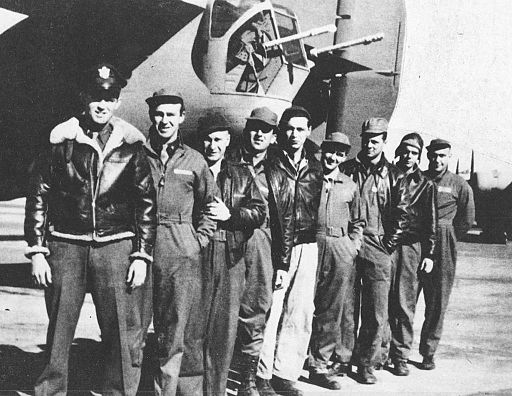
Taken by the boy’s passion, friends and neighbors sometimes contributed to his collection. Mr. Cordial, two doors down, gave him the wings he pinned to his own uniform. He once flew bombing runs over Germany.
Another neighbor, intent on reclaiming space in his basement, gave him a box of camouflage pants and jackets including a flack jacket that he had worn in the Grenada invasion. Though not vintage WWII, it was a real flack jacket worn in real combat – a special treasure. The boy was certain that anyone who knew its history would forgive its inclusion with his gear, at least until a vintage version came along.
His collection had truly expanded, but the helmet eluded him.
Patience
Delayed gratification is a must when one’s funds come primarily from birthday and Christmas money, coupled with a meager allowance. During the long savings phase of the helmet acquisition project he learned about army surplus stores, (and that none were close by). He learned about how much money he’d have to save to make his purchase (he kept saving). He secured his father’s promise to handle logistics when the time for purchase actually came (and it did).
One triumphant Saturday morning, money in hand, he made the trip with his dad to a surplus store an hour away and returned much later . . . without a helmet.
While he examined gear at the store he realized for the very first time that a helmet was of little use without an additional item that every G.I. wore concealed under his helmet: a helmet liner.
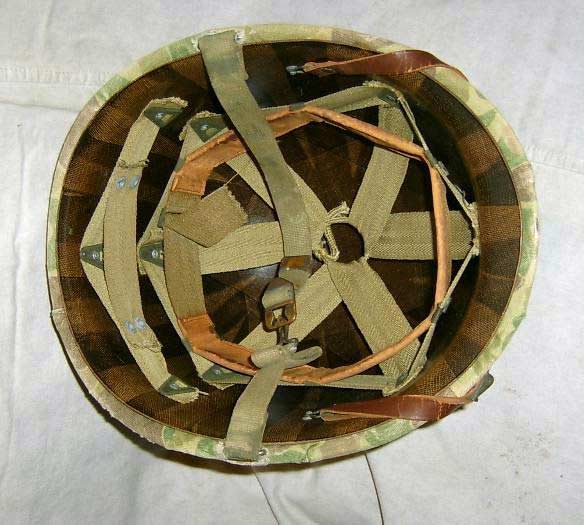
On the outside, a helmet liner looked like his plastic play helmet. On the inside though, it contained web straps that fit snugly over his head to buffer it from the heavy metal of the actual helmet. The liner provided a good fit for the helmet. It also sported its own price tag – additional cost he hadn’t anticipated. Sadly, he realized that he could purchase the helmet or the liner, but not both.
“You have money in your pocket, dad, don’t you?” he asked hopefully, a helmet in one hand and liner in the other.
“Yes,” replied dad, “I have money in my pocket, but not for this. This is your purchase. It looks to me like you need to make a choice.”
Coming home with the liner and not the helmet was a bit anticlimactic. Still, he knew how to save. He knew also that he could reach his goal.
Truthfully, the waiting and saving process wasn’t so bad. Weekly, he learned new things about WWII. Books and movies and talks with grown up veterans gave his “pretend” soldiering new meaning.
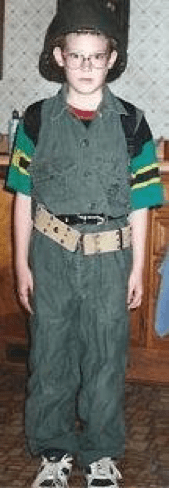
No longer did he fight some generic battle against nondescript “bad guys” in vague, unnamed places. Now he was at places where these veterans had been.
And these clothes that he put on were not mere play clothes. They were a collection of real soldier stories and memories.
He wore the personal combat histories of men he’d met, men he knew — encircling his waist, covering his shoulders and chest, strapped under his chin and bloused at his boot tops. He wore their experiences pinned to his shirt over his heart and slung over his back. He wore the confidence and bravery of half a dozen men who (in his admiring, seven-year-old eyes) had truly dressed for success.
 Morris Sampler